

- 1. Design: The LARK A2 Is Seriously Small
- 2. Audio Quality: 48 kHz / 24-bit
- 3. AI Noise Cancellation
- 4. Safety Track: An Important Feature for Video Creators
- 5. Battery Life: A Major LARK A2 Advantage
- 6. Wireless Range
- 7. The DJI Mic 2's Biggest Advantage: Internal Recording
- 8. Receiver and Connectivity
- 9. Ease of Use
- 10. Portability: LARK A2 vs DJI Mic 2
- 11. Price: LARK A2 Is Positioned Much Lower
- 12. LARK A2 vs DJI Mic 2: Which Features Matter Most?
- 13. What Makes the Hollyland LARK A2 Different?
- 14. Who Should Consider the LARK A2?
- 15. Who Should Consider the DJI Mic 2?
- 16. LARK A2 vs DJI Mic 2: The Real Difference
- Final Thoughts
If you are looking for a compact wireless microphone for vlogging, interviews, livestreaming, TikTok videos, YouTube, or mobile content creation, two names worth looking at are the Hollyland LARK A2 and DJI Mic 2.
Both systems are designed to make wireless audio easier, but they take somewhat different approaches.
The Hollyland LARK A2 puts a strong emphasis on being extremely small and lightweight, AI-powered noise cancellation, quick setup, safety-track recording, and a simple clip-and-go workflow. The DJI Mic 2, meanwhile, focuses more heavily on professional flexibility, including internal recording, 32-bit float recording, a touchscreen receiver, and broader camera connectivity.
After looking at the specifications and feature sets, the interesting question isn’t simply which microphone has more features. It’s which system makes more sense for your particular workflow?
In this comparison, we’ll take a closer look at the Hollyland LARK A2 vs DJI Mic 2, with particular attention to what makes the LARK A2 different.
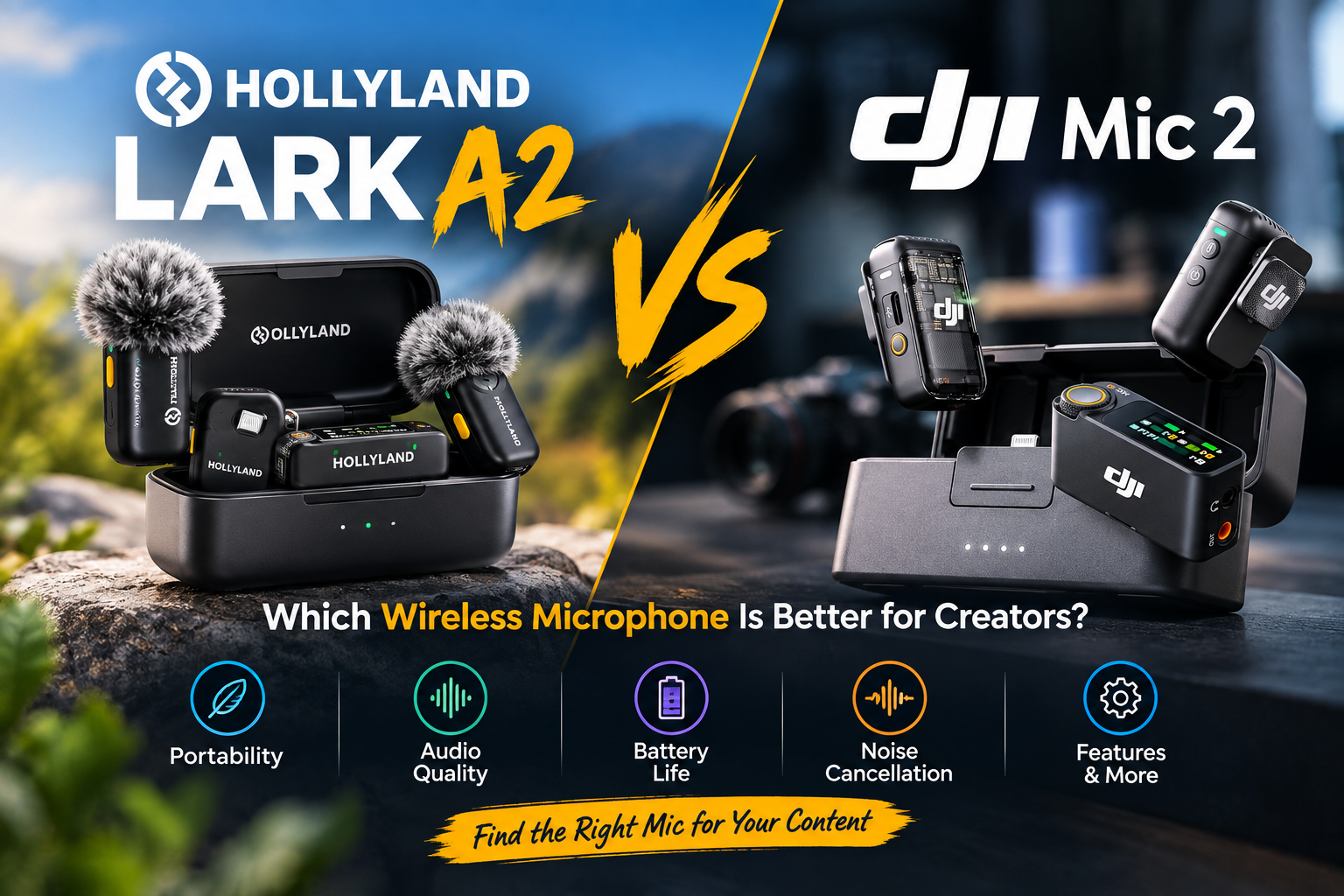
Hollyland LARK A2 vs DJI Mic 2: Quick Comparison
| Feature | Hollyland LARK A2 | DJI Mic 2 |
|---|---|---|
| Audio resolution | 48 kHz / 24-bit | 48 kHz / 24-bit + 32-bit float internal recording |
| Noise cancellation | AI noise cancellation, 3 levels | Intelligent noise cancelling |
| Maximum wireless range | Up to 200 m LOS | Up to 250 m FCC / 160 m CE |
| Transmitter battery | Up to 7 hours | Up to 6 hours |
| Total battery with case | Up to 42 hours | Up to 18 hours |
| Transmitter weight | Approx. 8.5 g | Approx. 28 g |
| Internal recording | Safety Track | Yes, up to 14 hours |
| Safety track | Yes, -6 dB | Yes, -6 dB in supported mode |
| Quick charging | 5 minutes = up to 1 hour | — |
| Receiver | Compact mobile receiver | Dedicated receiver with touchscreen |
| Smartphone workflow | Designed around mobile shooting | Smartphone, camera and computer focused |
| AI power saving | Yes | — |
| AI voice tuning | Yes | — |
| AI auto-limit clip | Yes | — |
| Charging case | Duo version | Included with 2-TX combo |
| Official price checked | From $29.99 / Duo $44.99 on Hollyland Store | From $129 / 2-TX combo $199 on DJI Store |
Specifications and prices can vary by package, region and promotions. The prices above are the official-store prices/pages checked at the time of writing.
1. Design: The LARK A2 Is Seriously Small

One of the first things you notice about the LARK A2 is its size.
Each LARK A2 transmitter weighs approximately 8.5 grams, making it considerably smaller and lighter than the DJI Mic 2 transmitter, which weighs approximately 28 grams.
That difference matters when you are wearing the microphone for an extended period.
The LARK A2 transmitter measures approximately 37.7 × 19.8 × 10 mm, giving it a very discreet appearance when clipped onto a shirt, jacket, or other clothing.
The DJI Mic 2 is still compact, but its transmitter is physically larger because it includes additional hardware such as internal storage and a more substantial control system.
Why the LARK A2’s size matters
For creators who record:
- TikTok and short-form videos
- YouTube Shorts
- Instagram Reels
- Walking vlogs
- Travel videos
- Interviews
- Livestreams
- Mobile videos
a smaller transmitter can simply be more convenient.
You can clip it on and largely forget that you’re wearing a microphone.
This is one of the strongest characteristics of the LARK A2.
2. Audio Quality: 48 kHz / 24-bit
The LARK A2 records audio at 48 kHz / 24-bit, which is the resolution you would expect from a modern wireless microphone aimed at video creators.
It also features an omnidirectional microphone capsule, a frequency response of 20 Hz–20 kHz, a signal-to-noise ratio of at least 68 dB, and a maximum SPL of 120 dB.
For voice-focused content, this provides the basic technical foundation for clean and detailed dialogue.
The DJI Mic 2 also supports 48 kHz / 24-bit audio, but its biggest advantage in this area is the ability to record internally using 32-bit float. Each DJI transmitter includes 8 GB of internal storage capable of storing up to 14 hours of uncompressed 48 kHz / 24-bit audio, with 32-bit float internal recording supported.
That makes the DJI system particularly interesting for creators who want a standalone backup recording.
Where the LARK A2 takes a different approach
Instead of building the system around large onboard storage, Hollyland focuses the LARK A2 on a lightweight wireless workflow and adds features such as:
- AI Noise Cancellation
- AI Voice Tuning
- AI Auto-Limit Clip
- Safety Track
- AI Power Saving
So the LARK A2 is less about turning the transmitter into a miniature audio recorder and more about making the process of getting clean audio quickly as simple as possible.
3. AI Noise Cancellation
This is one of the main features Hollyland is highlighting with the LARK A2.
The system provides three levels of AI-driven noise cancellation, with Hollyland claiming up to 20 dB of noise cancellation depth.
The idea is straightforward:
Clip the microphone on → select the appropriate noise-cancellation level → start recording.
For outdoor creators, this can be useful when dealing with environmental noise such as traffic, crowds, fans, or general background noise.
The LARK A2 gives you three levels:
- Low
- Medium
- High
This lets you choose how aggressively the background noise should be reduced.
The DJI Mic 2 also has intelligent noise cancelling, so noise reduction isn’t exclusive to Hollyland. However, the LARK A2 makes AI processing a central part of its small, mobile-focused workflow.
An important point about noise cancellation
Noise cancellation should not automatically be treated as “better sound.”
Aggressive processing can sometimes change the natural character of a voice.
For that reason, the ability to select different levels is useful. In a relatively quiet environment, you may prefer less processing, while a busy outdoor location may justify a stronger setting.
4. Safety Track: An Important Feature for Video Creators
One of the LARK A2’s useful recording features is Safety Track.
The system can record a secondary backup track at -6 dB, giving you another version of the audio with lower gain.
Why does this matter?
Imagine recording an interview and your subject suddenly laughs loudly or speaks much louder than expected.
If your primary track clips badly, recovering that distorted audio in post-production can be difficult.
A lower-level safety recording gives you another option.
The DJI Mic 2 also offers a Mono with Safety Track mode that records a backup soundtrack at -6 dB.
So both systems provide protection against unexpected peaks.
5. Battery Life: A Major LARK A2 Advantage
Battery life is another area where the LARK A2 has impressive numbers.
Hollyland rates the LARK A2 transmitter for up to 7 hours of operation.
With the charging case, the Duo version can reach up to 42 hours of total battery life. Hollyland also says that AI power-saving can extend a transmitter’s runtime to up to 9 hours in certain conditions.
The system also supports quick charging:
5 minutes of charging can provide up to 1 hour of shooting.
That is particularly useful when you discover that your microphone battery is almost empty just before recording.
The DJI Mic 2 transmitter is rated for up to 6 hours, while the 2-TX charging-case configuration provides up to 18 hours of total operating time.
So on the published battery figures, the LARK A2 has considerably more total runtime with its charging case.
For creators who record throughout the day, that can be a meaningful difference.
6. Wireless Range
Hollyland rates the LARK A2 for up to 200 meters / 650 feet line-of-sight transmission.
That figure is measured under controlled conditions, so real-world range can vary depending on interference, obstacles, buildings, people and other wireless devices.
The DJI Mic 2 is rated for up to 250 meters / 820 feet under FCC conditions, while the stated CE maximum is 160 meters in an unobstructed environment without interference.
On paper, the DJI Mic 2 has the higher maximum FCC range.
But for typical close-range vlogging, interviews, livestreaming and social-media content, you are unlikely to need hundreds of meters of separation.
In other words, range specifications are important, but they should be considered alongside the actual shooting environment.
7. The DJI Mic 2’s Biggest Advantage: Internal Recording
This is probably the most important difference between these two systems.
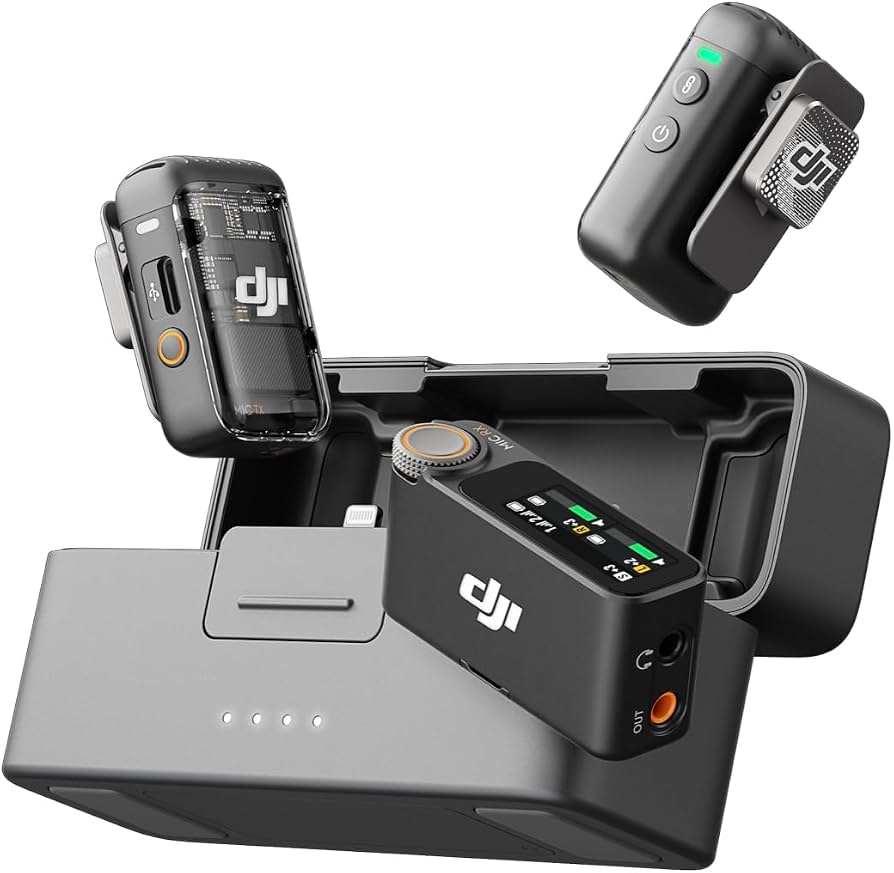
The DJI Mic 2 transmitters have 8 GB of internal storage, allowing each transmitter to store up to 14 hours of uncompressed audio. The system also supports 32-bit float internal recording.
This means you can have an additional recording inside the transmitter itself.
That is particularly valuable for:
- Professional interviews
- Documentary work
- Weddings
- Commercial productions
- Long-form filmmaking
- Situations where wireless interference is a concern
The LARK A2 instead focuses on its wireless connection and safety-track workflow.
So if internal backup recording and 32-bit float are high on your priority list, the DJI Mic 2 has a clear specification advantage.
But that doesn’t automatically make it the better choice for every creator.
For someone primarily recording social-media videos with a smartphone, the LARK A2’s lighter body and simpler workflow may be more relevant.
8. Receiver and Connectivity
The LARK A2 is designed around a compact mobile receiver and a straightforward plug-and-record workflow.
Hollyland also highlights MFi certification, pass-through charging, independent transmitter/receiver mute controls and plug-free playback as part of the LARK A2 workflow.
This makes the system particularly attractive to smartphone-first creators.
The DJI Mic 2 takes a broader approach.
Its receiver can connect to cameras using a 3.5 mm TRS connection, while the system also supports USB-C and Lightning connections for mobile devices. The receiver additionally features a 1.1-inch touchscreen and dial for controlling settings.
The DJI system therefore has a more traditional “production microphone system” approach.
The LARK A2 is more minimalist.
9. Ease of Use
This is where Hollyland’s “Clip & Go” idea makes sense.
The LARK A2 transmitters are pre-paired and designed to be ready to use quickly. The transmitter itself weighs only around 8.5 grams, and the system provides onboard controls for common operations.
Hollyland’s control scheme includes:
- One press for noise cancellation
- Two presses for mute
- Three presses for recording
That means you don’t necessarily have to interact with a phone or receiver for every basic operation.
The DJI Mic 2 provides considerably more control through its touchscreen receiver.
That’s useful for users who want detailed configuration.
But there is also a trade-off:
More control can mean more complexity.
For someone who simply wants to clip on a microphone and start filming, the LARK A2’s minimalist approach is appealing.
10. Portability: LARK A2 vs DJI Mic 2
This is probably one of the easiest differences to understand.
LARK A2
Approx. 8.5 g per transmitter
DJI Mic 2
Approx. 28 g per transmitter
That means each DJI Mic 2 transmitter is more than three times the weight of a LARK A2 transmitter.
For a studio setup, that difference may not matter.
For someone wearing a microphone on their shirt while walking around all day, it can.
The LARK A2 almost disappears once clipped onto clothing.
That is a major part of its appeal.
11. Price: LARK A2 Is Positioned Much Lower
At the time of checking the official stores, Hollyland lists the LARK A2 starting at $29.99 for the Solo, with the Duo version listed at $44.99 on its U.S. store.
DJI lists the Mic 2 at $129 for the 1-TX + 1-RX version and $199 for the 2-TX + 1-RX charging-case combo on its U.S. store.
Prices can change with promotions, regions and package configurations, but the difference in positioning is significant.
The LARK A2 is aimed at making a compact wireless microphone system accessible to a much wider range of creators.
The DJI Mic 2 is positioned as a more feature-heavy production system.
12. LARK A2 vs DJI Mic 2: Which Features Matter Most?
Instead of looking at one specification in isolation, here’s how the two systems differ in practical use.
| Category | Hollyland LARK A2 | DJI Mic 2 |
|---|---|---|
| Lightweight design | 8.5 g TX | 28 g TX |
| Audio resolution | 48 kHz / 24-bit | 48 kHz / 24-bit + 32-bit float internal |
| Noise reduction | 3-level AI noise cancellation | Intelligent noise cancelling |
| Internal backup recording | Safety Track | 8 GB internal storage |
| Long recording sessions | Up to 42h with case | Up to 18h with case |
| Maximum stated range | 200 m LOS | 250 m FCC / 160 m CE |
| Smartphone-first workflow | Strong focus | Broad compatibility |
| Camera production | Mobile-focused | Strong camera support |
| Receiver controls | Simple | 1.1″ touchscreen + dial |
| Portability | Extremely compact | Compact |
| 32-bit float | No | Yes |
| Quick charging | 5 min = 1h | — |
| AI power saving | Yes | — |
| Price positioning | Lower | Higher |
13. What Makes the Hollyland LARK A2 Different?
The LARK A2 isn’t trying to win every specification battle.
Instead, Hollyland has concentrated on several things that matter to everyday creators:
1. Extremely lightweight transmitters
At approximately 8.5 grams, the LARK A2 is designed to stay discreet when worn.
2. AI noise cancellation
The three-level AI noise cancellation system is designed to make recording cleaner in environments where controlling background noise isn’t possible.
3. Long battery life
Up to 7 hours per transmitter and up to 42 hours with the Duo charging case give the system plenty of endurance.
4. Safety Track
The -6 dB backup track gives creators another layer of protection against unexpected loud sounds.
5. Fast charging
Five minutes of charging can provide up to one hour of shooting.
6. Simple workflow
The “Clip & Go” concept is perhaps the biggest theme of the LARK A2.
Instead of making the microphone itself the center of attention, the system is designed to stay out of the way.
14. Who Should Consider the LARK A2?
The LARK A2 makes particular sense for creators who prioritize:
- Lightweight equipment
- Smartphone filmmaking
- TikTok and Instagram content
- YouTube Shorts
- Vlogging
- Livestreaming
- Travel videos
- Interviews
- Outdoor recording
- Quick setup
- Long battery life
- AI noise reduction
- A discreet microphone
If your typical workflow is:
Take microphone → clip it on → connect receiver → open camera → record
the LARK A2 fits that philosophy very well.
15. Who Should Consider the DJI Mic 2?
The DJI Mic 2 becomes particularly interesting when your requirements move toward professional production.
Its internal 8 GB storage, 32-bit float recording, touchscreen receiver, 3.5 mm camera connectivity and broader device compatibility make it a more feature-rich system for users who want more control and recording redundancy.
It can therefore be attractive for:
- Professional videographers
- Documentary creators
- Interview production
- Camera-based filmmaking
- Users who need internal recordings
- Creators who want 32-bit float recording
- Multi-device workflows
16. LARK A2 vs DJI Mic 2: The Real Difference
The biggest difference isn’t simply 200 meters vs 250 meters or 7 hours vs 6 hours.
It’s the philosophy behind each product.
The DJI Mic 2 is built as a more comprehensive wireless production system. It gives you internal storage, 32-bit float recording, a touchscreen receiver and extensive connectivity.
The Hollyland LARK A2 takes a different route.
It concentrates on being small, lightweight, easy to operate and highly convenient for everyday content creation, while adding modern features such as AI noise cancellation, AI voice tuning, AI power saving, auto-limit clipping and a safety track.
And that’s what makes the LARK A2 interesting.
You don’t necessarily need the microphone with the longest specification sheet.
Sometimes you need the microphone that you can clip on, forget about and start creating.
Final Thoughts
The Hollyland LARK A2 and DJI Mic 2 are designed with different priorities in mind.
The DJI Mic 2 offers a deeper professional feature set, particularly with its internal recording, 32-bit float capability, touchscreen receiver and broader production connectivity.
The LARK A2 puts much more emphasis on portability, simplicity, AI-powered noise reduction, battery life and fast mobile content creation.
Its 8.5-gram transmitter is one of its biggest physical advantages, while features such as the 42-hour maximum battery figure with the Duo case, Safety Track, three-level AI noise cancellation and quick charging make it particularly well suited to creators who want a lightweight system that doesn’t interrupt their workflow.
For a creator who needs a full production-oriented wireless microphone with onboard recording and 32-bit float, the DJI Mic 2 provides those capabilities.
For creators who prioritize small size, simplicity, long battery life and quick smartphone content creation, the LARK A2 deserves a serious look.
Ultimately, the right choice depends on whether your workflow needs the DJI’s additional recording and production features or whether the LARK A2’s lightweight “Clip & Go” approach better matches the way you create.
Hollyland LARK A2 Specifications
- Audio: 48 kHz / 24-bit
- Microphone: Omnidirectional
- Frequency response: 20 Hz–20 kHz
- SNR: ≥68 dB
- Maximum SPL: 120 dB
- Wireless range: Up to 200 m line of sight
- Transmitter weight: Approx. 8.5 g
- Transmitter battery: Approx. 7 hours
- Total battery with Duo case: Up to 42 hours
- AI noise cancellation: Yes, 3 levels
- Safety Track: Yes, -6 dB
- AI power saving: Yes
- AI voice tuning: Yes
- AI auto-limit clip: Yes
- Quick charging: 5 minutes for up to 1 hour of shooting
- Charging case: Available with Duo package
Specifications are based on Hollyland’s published specifications; actual performance can vary with environment and usage.
Frequently Asked Questions
Is the Hollyland LARK A2 better than the DJI Mic 2?
The two microphones prioritize different features. The DJI Mic 2 offers internal recording and 32-bit float recording, while the LARK A2 emphasizes a much lighter transmitter, AI noise cancellation, long battery life and a simple mobile workflow.
Does the LARK A2 record in 24-bit?
Yes. The LARK A2 supports 48 kHz / 24-bit audio recording.
How long does the LARK A2 battery last?
Each transmitter is rated for approximately 7 hours, while the Duo charging case can provide up to 42 hours of total battery life. Hollyland says AI power saving can extend transmitter runtime to up to 9 hours in certain conditions.
Does the LARK A2 have noise cancellation?
Yes. The LARK A2 features three levels of AI-driven noise cancellation, with Hollyland claiming up to 20 dB of noise cancellation depth.
Does the LARK A2 have a safety track?
Yes. The Safety Track feature records a secondary backup track at -6 dB.
Does the DJI Mic 2 have internal recording?
Yes. Each DJI Mic 2 transmitter has 8 GB of internal storage and can record up to 14 hours of uncompressed 48 kHz / 24-bit audio. It also supports 32-bit float internal recording.
Which microphone is lighter?
The LARK A2 transmitter weighs approximately 8.5 grams, while the DJI Mic 2 transmitter weighs approximately 28 grams.
Does the LARK A2 have 32-bit float recording?
No. The LARK A2 uses 48 kHz / 24-bit recording. The DJI Mic 2 supports 32-bit float internal recording.