


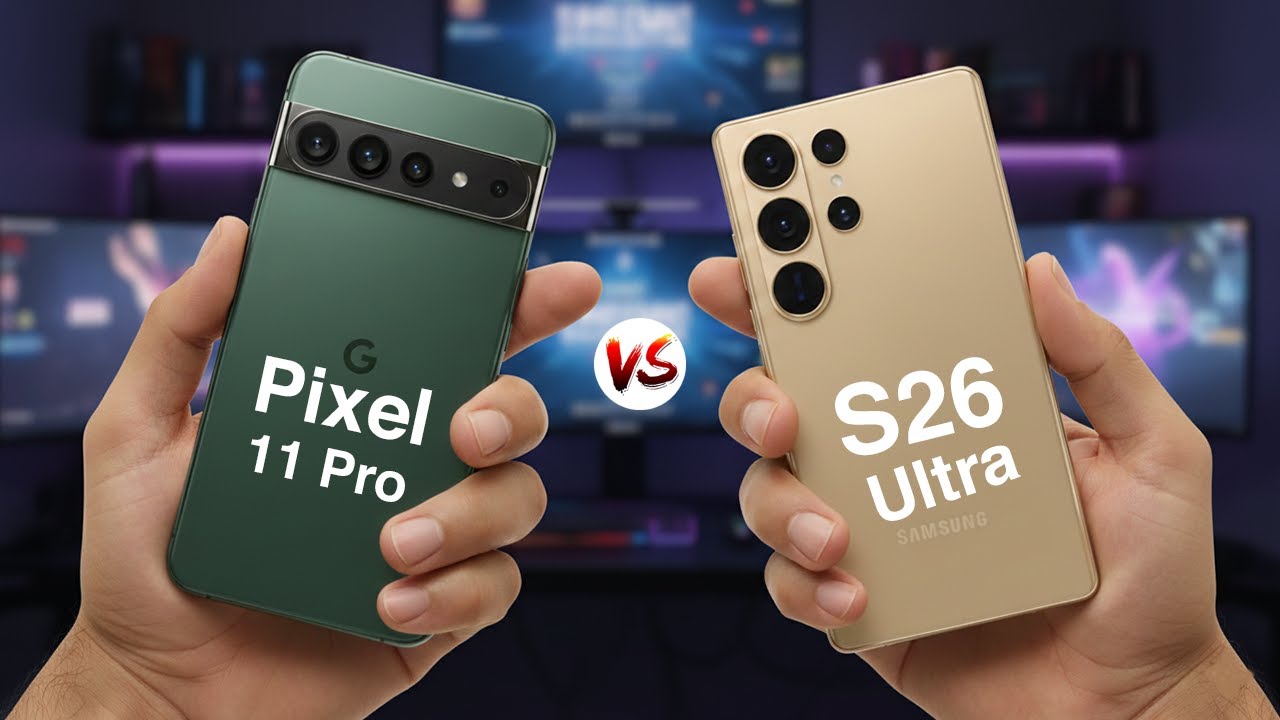
One phone is already in millions of pockets worldwide. The other is still in the lab — but the leaks are loud. The Samsung Galaxy S26 Ultra launched in March 2026 as Samsung’s most refined flagship yet, while the Google Pixel 11 Pro is shaping up to be arguably the most anticipated Android phone in years. Here’s how they stack up with Google Pixel 11 Pro vs Samsung Galaxy S26 Ultra.
The contenders at a glance
The Galaxy S26 Ultra arrived with Samsung billing it as its “most powerful hardware ever on a Galaxy S series,” promising more agentic AI experiences. It’s been reviewed thoroughly, praised for its speed and camera, and has been on sale since March 11, 2026.
The Pixel 11 Pro, by contrast, is still forthcoming. Google is expected to unveil the Pixel 11 Pro at a mid-August “Made by Google” event, with the phone going on sale shortly after. What we know comes from leaks, CAD renders, and supply chain reports — but the picture is already compelling.
Design and display
The S26 Ultra is a big, bold slab. It carries a 6.9-inch Dynamic AMOLED 2X panel at QHD+ resolution, with LTPO adaptive refresh between 1 Hz and 120 Hz and HDR10+ support, protected by Corning Gorilla Armor 2. After two generations with titanium, Samsung returned to aluminum for the frame in 2026, dubbing it “Armor Aluminum,” and the phone now measures 163.6 x 78.1 x 7.9 mm at 214 grams — marginally slimmer and lighter than its predecessor.
The Pixel 11 Pro (“Grizzly”) is expected to keep its compact proportions. CAD renders show dimensions of approximately 152.7 x 71.8 x 8.4 mm, keeping the Pixel 11 Pro in the same size class as the Pixel 10 Pro. Crucially, a new report suggests the Pixel 11 range will receive Samsung’s brand-new M16 OLED panels, which would deliver brighter output, more accurate color, and improved power efficiency compared to the M14 panels used in the Galaxy S26. That’s a remarkable development — Google’s phone could potentially have a superior panel to Samsung’s own flagship.
Edge: Slight advantage to the Pixel 11 Pro on display tech if leaks hold; the S26 Ultra wins on size and sheer screen real estate.
Performance and chipset
This is where the Pixel 11 Pro’s potential is most exciting. The Tensor G6 is reportedly built on TSMC’s 2nm manufacturing process, promising improved performance and efficiency through increased transistor density. The chip uses a 7-core architecture with one ultra-core clocked at 4.11 GHz, with Google deliberately trading one core for better thermal management and sustained performance. Apple’s A18 Pro uses 3nm — Google moving to 2nm represents a genuine generational statement.
The S26 Ultra counters with proven silicon. It runs the Snapdragon 8 Elite Gen 5 on a 3nm process, featuring an octa-core design with two cores clocked at 4.74 GHz and six efficiency cores at 3.62 GHz, paired with an Adreno 840 GPU. In real-world testing, the experience is exceptionally smooth. Reviewers found a fast and seamless experience whether scrolling apps, streaming video, or switching camera functions.
On paper, the Pixel 11 Pro’s 2nm chip could be more efficient, but as past Tensor generations have shown, a process node advantage doesn’t always translate into raw benchmark dominance against Qualcomm rivals.
Edge: S26 Ultra for proven performance; Pixel 11 Pro for potential efficiency gains.
Camera system
Photography is the most fiercely contested arena between these two.
The S26 Ultra’s camera system is extensive. The most notable changes this year are an aperture upgrade for the primary 200 MP camera, which now has a faster f/1.4 lens compared to the previous f/1.7, and improvements to the 5x periscope telephoto. Samsung also introduced a wider aperture that allows the sensor to collect 47% more light for brighter photos in low-light conditions, alongside a Super Steady video feature that uses gyro and accelerometer data to automatically lock the horizon in footage. The hardware muscle is undeniable, though Samsung’s processing remains characteristically aggressive — colors are boosted, sharpening is heavy in auto mode, and zoom shots show the mottling typical of Samsung’s noise suppression approach.
The Pixel 11 Pro is expected to continue Google’s AI-first philosophy. Key rumored innovations include ultra-low-light video recording capable of capturing detailed footage in near-total darkness of 5–10 lux. Some leaks suggest a new 64 MP periscope telephoto camera with up to 10x optical zoom, though these remain unconfirmed from top-tier sources. Pixel cameras are famous for natural skin tones, accurate color science, and computational photography that outpunches hardware specs.
Edge: S26 Ultra on optical versatility; Pixel 11 Pro likely leads on natural processing and low-light video.
AI features and software
Both phones are betting heavily on AI — but their approaches differ philosophically.
Samsung’s Galaxy AI suite on the S26 Ultra features a world-first built-in Privacy Display that narrows the screen’s viewing angle so bystanders cannot read your content, while the owner’s direct view remains unaffected. Galaxy AI also expands across productivity and creativity, with the updated Bixby assistant becoming more central to the experience.
Google’s Gemini integration in Android 17 is expected to be even deeper and more native. The Pixel 11 Pro series is launching with Android 17, and Google has pledged seven years of software support including regular updates and security patches. Reports also indicate an under-display infrared camera for secure face unlock is returning to the Pixel line for the first time since the Pixel 4 in 2019. Additionally, the Tensor G6 is expected to include the Titan M3 chip for enhanced security, addressing cybersecurity concerns as more of daily life moves to mobile.
Edge: Tie — Samsung leads on unique hardware AI features today; Google leads on clean Android integration and longevity.
Battery and charging
The S26 Ultra retains a 5,000 mAh battery and introduces faster charging for the first time in the Galaxy S Ultra lineup, with 60W wired charging and 25W wireless charging now supported. However, no charger is included in the box — you’ll need a Power Delivery charger rated at 60W with PPS support.
Pixel 11 Pro battery details remain unconfirmed, but Google’s Tensor G6 on 2nm should deliver better efficiency per watt, potentially stretching battery life without requiring a larger cell.
Edge: S26 Ultra on confirmed charging speeds; Pixel 11 Pro holds potential here with more efficient silicon.
Price and value
The Galaxy S26 Ultra starts at $1,299 — the same as its predecessor — though larger storage variants have seen price increases, with the 1TB option notably more expensive.
The Pixel 11 Pro is expected to be priced similarly to the Pixel 10 Pro, which started at $999. That $300 gap is significant, and if the Pixel 11 Pro delivers on its hardware promises, it may represent one of the best value propositions in the premium Android space.
Edge: Pixel 11 Pro by a meaningful margin, assuming pricing holds.
The verdict
The Samsung Galaxy S26 Ultra is an excellent phone you can buy today — refined, powerful, and packed with thoughtful additions like Privacy Display and a genuinely fast camera. It delivers more meaningful improvements than the S25 Ultra, even if it remains an incremental evolution rather than a revolutionary leap.
The Google Pixel 11 Pro is a phone worth waiting for. A 2nm chip, next-generation Samsung OLED panels, deeper Gemini integration, returning IR face unlock, and a competitive $999 price point form a potentially devastating combination. The wild card, as always with Pixel, is execution — leaks paint a promising picture, but Google will need to deliver where past Tensor generations occasionally stumbled on sustained performance.
Buy the S26 Ultra if you want Samsung’s productivity ecosystem, an S Pen, the biggest and brightest display available, and you need a phone now. Wait for the Pixel 11 Pro if you value clean software, Google’s AI, compact flagship design, and want the best value in premium Android later this year.
The Pixel 11 Pro has not yet launched. All specifications are based on leaks, CAD renders, and supply chain reports as of April 2026. Final specs are subject to change.

